
Asahi Super Dry takes over Piccadilly Lights with artist-inspired, AI-powered ad that’s never the same twice
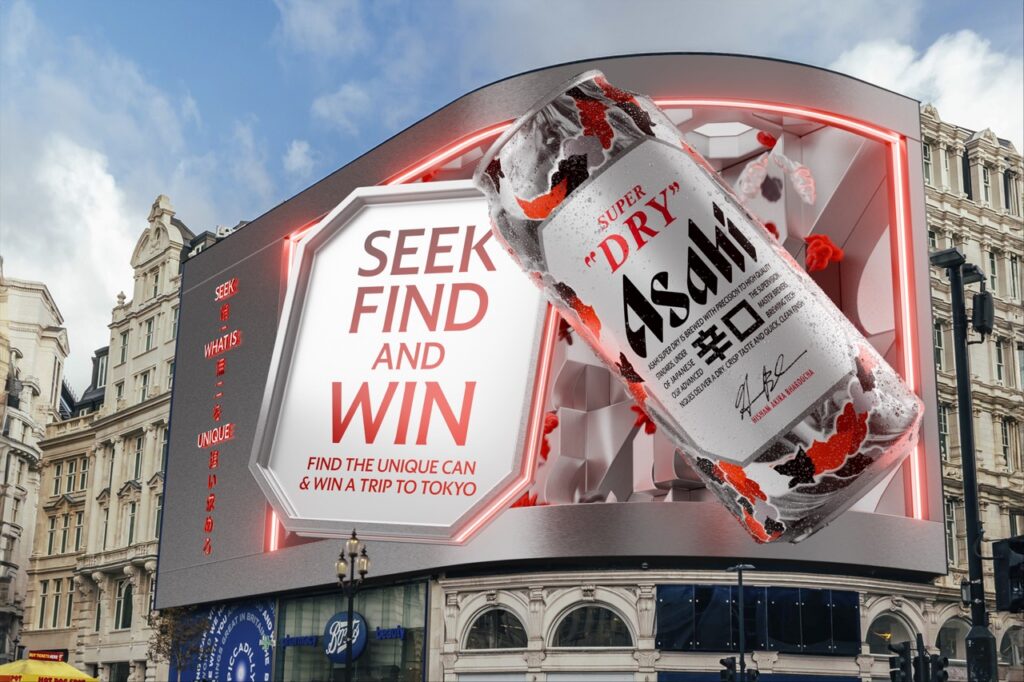
POP and Havas London collaborated with Japanese-born artist Hisham Akira Bharoocha to launch Asahi Super Dry’s multi-million ‘Seek, Find & Win’ competition. Inspired by Asahi Super Dry’s global brand platform ‘Seek What Is Unique,’ it includes a major new advertising campaign, combining original artwork with the power of generative AI to create a Piccadilly Circus outdoor ad that’s never the same twice, as well as a stunning, limited edition can, designed by Bharoocha, which sits at the heart of Asahi Super Dry’s new multi-million-pound competition and activations.
‘The Infinite Can’, which debuts with a week-long takeover of London’s iconic Piccadilly Lights, was created by Havas London and POP in close collaboration with Bharoocha. Underpinning the innovative campaign is the Asahi Fusion Designer – a custom-built orchestration tool developed by POP within its proprietary generative AI platform, Vermeer.ai – blending artistic and artificial intelligence to create more than 400 unique designs to be showcased over the course of the week.
This system was fed exclusively on Bharoocha’s artistic output, creative process and influences, and programmed not to mimic style, but to decode sentiment, unearthing themes and connections unique to Bharoocha. Bharoocha remained an active participant throughout the process – curating source material, steering nuance and ultimately deciding what felt like his work and what didn’t.
Like Asahi Super Dry, Bharoocha – who was born in Japan and is now based in New York – boasts a unique cross-cultural perspective, with an east-meets-west lens that comes through in his work, blending internal and external worlds through graphic connections. The result saw this artistic DNA translated into over 400 original artworks, inspired by Japan and rendered in Asahi’s brand palette.
The striking Piccadilly Lights takeover – which includes a showstopping 3D hero can designed specifically for high-impact OOH placements – will be supported by additional outdoor advertising, as well as social and online video, until the end of September.
Live from today, ‘Seek, Find & Win’ is a multi-million-pound promotion to build excitement into Asahi Super Dry’s global brand platform, Seek What Is Unique, which guides premium beer drinkers to a more interesting side of life and encourages them to explore a world of colour, creativity and symbolism.
It sees Asahi Super Dry roll out a striking limited edition can and bottle, designed by Bharoocha, across one million packs of Asahi Super Dry and Asahi Super Dry 0.0%. UK consumers who discover the unique bottle or can in these packs could win one of several once-in-a-lifetime trips to Tokyo, the home of Asahi Super Dry, with a guest.
‘Seek, Find & Win’ will also be present in the on-trade, where consumers will be challenged to find tokens in all Asahi Super Dry draught stockists to win prizes including merch, pre-loaded credit cards to be redeemed on pints, and one of four trips to Tokyo.
Bharoocha’s creative designs and innovative packaging concept will also include exclusive point of sale executions, support and merchandise to ensure Asahi Super Dry is unmissable in pubs, bars, convenience stores and grocery retailers up and down the UK.
Behind the Asahi Fusion Designer
Havas London, in collaboration with Bharoocha, defined the creative vision — POP brought it to life by leading the end-to-end delivery and realisation of the concept at scale.
At the heart of the campaign is a bespoke AI system designed to translate Bharoocha’s distinctive artistic language into a scalable production system without ever directly replicating his work. Instead, the process begins with a deep analysis phase, where core elements such as motifs, materiality, colour palettes and compositional principles are extracted and codified into a structured creative framework. This framework acts as the foundation for the entire system, ensuring that every output feels true to both the artist’s intent and the Asahi brand, while allowing for continuous variation.
From this foundation, POP developed a multi-stage generative pipeline that combines image models, language models and automation tools into a single controlled workflow. Reference artworks and structured prompts are fed into the system, where a language model interprets and translates them into precise instructions that guide the image generation process. This ensures that each output maintains the correct balance of artistic influence, brand integrity and photorealistic execution, with the can structure, label and core visual cues preserved consistently. The workflow is modular and repeatable, allowing different inputs such as new reference imagery or motifs to generate entirely new outputs while remaining within a defined visual system.
Automation sits at the centre of the workflow, enabling scale without compromising creative control. Once the creative parameters are defined, the system generates large volumes of imagery in a controlled and repeatable way, applying consistent rules across can generation, compositing, background integration and asset formatting. This is underpinned by an atomic content approach, where each component such as the can, label, texture, foreground and background elements is treated as a discrete, reusable asset. These components can be dynamically combined, adapted and reassembled through automation, allowing POP to create thousands of unique outputs while maintaining precision and consistency across every asset. Human oversight remains embedded throughout, with production and creative teams guiding testing, refinement and quality control to ensure each output meets the required standards of craft.
This approach enabled the creation of over 1000 unique can designs, each existing within its own distinct yet cohesive visual world. These assets were then fed into an automated video production pipeline, where 119 films were generated, each featuring seven variants of the cans. The automation of this stage ensured consistency in motion design, transitions, framing and output specifications, while accelerating production timelines and enabling high volume delivery across multiple channels. By leveraging atomic content within this process, individual elements could be reused and recombined across films, significantly increasing efficiency while maintaining creative variation.
The final stage of the workflow extends into hero asset creation, where selected designs are translated into a high-fidelity 3D representation. This culminates in a showstopping hero can end frame designed for high impact OOH placements including Piccadilly Lights, bringing together generative design, automation and crafted production into a single cohesive moment.
The result is a fully integrated AI driven production ecosystem that combines artistic direction, technical innovation and operational scale. By separating creative input from production output and embedding atomic content and automation throughout the pipeline, the project demonstrates how brands can move from static campaigns to dynamic, living systems. It is a model that balances precision, craft, scale and automation, creating a continuously evolving brand experience that remains both creatively distinctive and operationally efficient.
Want to see the Piccadilly Lights takeover? Check it out our Instagram and LinkedIn, and don’t forget to follow us to stay up-to-date on all your POP news!
Comments are closed.