
Borderless Takes: Nisha Kapur (Chennai) and Vlad Abramyants (NYC)
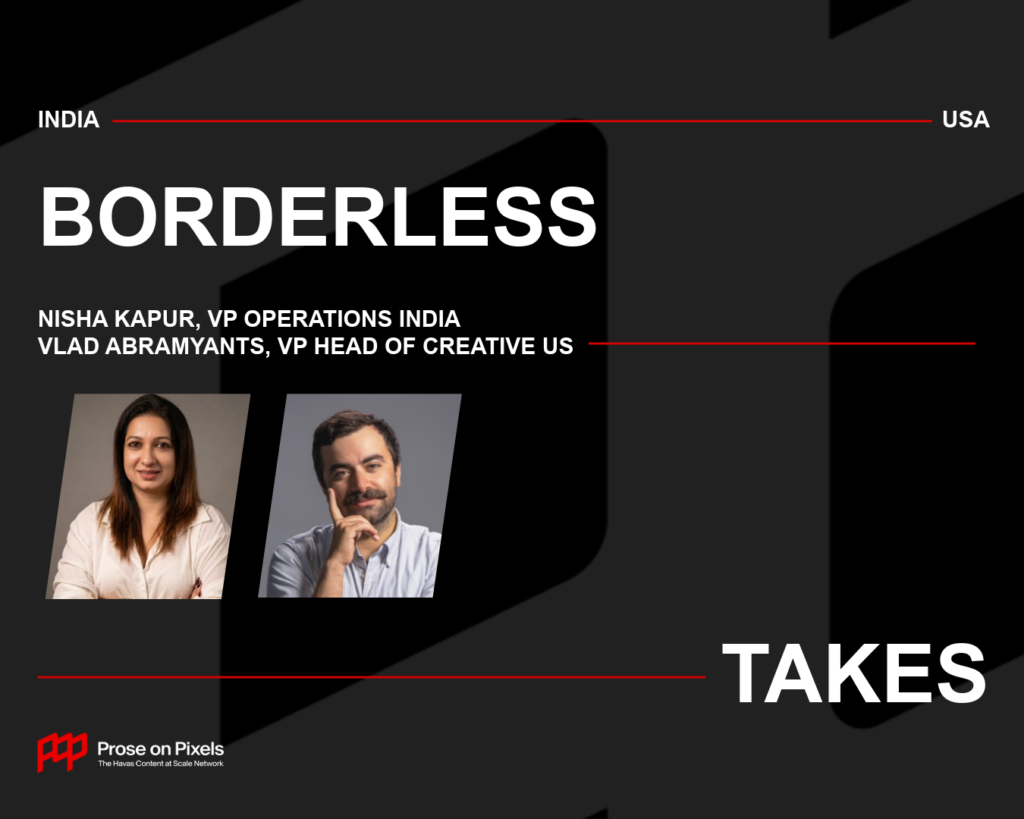
Being a borderless studio is integral to our identity and core functioning at POP. But what does it actually mean in practice? To give answers grounded in practical, real-life applications, we invited two colleagues — working on different continents, with different job functions — to interview each other.
Nisha Kapur, VP Operations in Chennai, India, and Vlad Abramyants, VP Head of Creative in New York City, USA each crafted three questions to ask the other. With insightful curiosities paired with thoughtful responses, the interview explores collaboration, cultural exchange, strategic integration, and the human element of working in our borderless environment.
NISHA ASKS VLAD:
NISHA: When you think about our collaboration across functions and geographies, what’s one thing that consistently elevates the work — and one thing we could do better?
VLAD: What consistently elevates our work is our truly decentralized, global talent pool. Because we don’t concentrate our talent into a single office or location, we can operate on a highly scalable, ‘follow-the-sun’ model. This means work never stalls; we maintain a consistently high standard of quality without being restricted by time zones or standard shift patterns. Furthermore, our global footprint acts as a natural stress-test for our creative. Because we have diverse studios and perspectives collaborating daily, local cultural nuances are heard, respected, and woven into our global campaigns from the ground up.
On the flip side, forecasting remains a challenge. Because production often sits at the tail end of the creative lifecycle, we are often at the mercy of many unknowns, such as timeline shifts, location changes, scope updates, media plan revisions, etc. To bridge this gap, we’ve implemented our global Workfront integration, which gives us much-needed visibility and predictive tracking. Combined with the inherent elasticity of the Prose on Pixels model, this setup allows us to rapidly flex and scale talent across different disciplines and time zones to meet those unexpected crunches.
NISHA: What’s one moment or project where you really felt the power of our global network come alive — and what made it work so well?
VLAD: A perfect example of this was a recent global campaign for a major financial services client, where we had to deliver hundreds of assets across every single market the client operates in. The workflow was a synchronized global engine: origination and creative execution was led out of the US with support from Costa Rica; retouching was driven by Prague with support in Manchester; localization, templating, and website updates were a collaborative effort between Costa Rica and India; video and final Quality Control (QC) were anchored by our team in India.
What made this massive undertaking work so seamlessly was the sheer connectivity within POP. We rely on airtight briefing processes, crystal-clear ownership lanes, and strict governance across every single asset. By establishing timelines upfront and enforcing a rigorous final QC layer before anything touched a vendor or DAM, we removed the friction. Ultimately, it comes down to trust. A campaign of this scale can look incredibly daunting on paper, but our teams were built for this level of complexity from day one.
NISHA: From your side, when does global collaboration really click — and when does it get tricky?
VLAD: Global collaboration really clicks when there is a clear, unified creative vision from the outset. Having that ‘North Star’ guides all of our teams in the same direction, while well-defined ownership lanes keep everyone focused on execution without stepping on each other’s toes.
It gets tricky when global campaigns are forced into local markets without understanding or respecting local nuances. If you don’t adapt the message, it won’t resonate. Fortunately, our ‘audience-first’ production model is designed to prevent this by building personalization directly into the brief from day one. By leveraging data and insights at the briefing stage, rather than treating localization as an afterthought, we ensure we aren’t just delivering one generic message. Instead, we create highly customized, personalized content tailored to what matters most to each individual audience in their specific market.
VLAD ASKS NISHA:
VLAD: We talk about being a ‘borderless studio’ — can you point to a specific project where that really showed up? What did the model actually enable there that a traditional hub-and-spoke setup couldn’t have?
NISHA: Label Updates — the regulatory label update for the work we deliver for our pharmaceutical clients — is a great example of our borderless studio model in action. Rather than routing work through a traditional hub-and-spoke structure, we leveraged talent across regions and functions as one integrated team.
This allowed us to scale resources quickly, balance capacity in real time, and maintain delivery momentum across time zones. The result was faster turnaround, greater flexibility during volume spikes, and consistent quality standards globally.
The key advantage was that work was owned by the network, not a location. Instead of handing work off between teams, we operated as a single production ecosystem — giving us the agility and scalability that a traditional hub-and-spoke model simply couldn’t match.
VLAD: As the studio’s gotten more global, has your sense of where great ideas come from shifted? Is there a project where the best thinking or execution came from a place people might not expect?
NISHA: Yes, absolutely. One of the biggest shifts for me has been realizing that great ideas aren’t confined to traditional creative centers — they often come from the people closest to the work.
A great example was the presentations initiative for a global client, which started as a request for presentation support but evolved into something far more strategic. What surprised many stakeholders was that the India team didn’t just execute the decks — we helped shaped the overall presentation experience from the ground up.
Some of the strongest thinking around content hierarchy, audience engagement, visualization of data, and platform-native storytelling came from the team building the work, rather than from the brief’s point of origin.
That project reinforced a key lesson: creativity isn’t defined by geography. In a borderless studio, the best ideas can come from anywhere, and our role is to create an environment where talent and expertise are recognized regardless of location. The presentations initiative among a few others was a great example of India being viewed not just as a production partner, but as a creative thought partner contributing directly to the outcome.
VLAD: Where do you see the biggest opportunity for us to deepen the India-global connection over the next year: is it in process, in talent, in culture, or something else entirely?
NISHA: If I had to choose one area, I’d say talent and connectivity. We’ve made tremendous progress on process and operational integration, but I’d say the next step is to continue to evolve the interconnectivity within the network with the power of our AI-driven structure.
As a global studio, our biggest opportunity is to reinforce the perception of POP as a truly borderless network when it comes to location and expertise. For India, that means creating more opportunities for creative, production, and operational talent in India to collaborate directly with global teams from the outset of projects — not just during execution.
When people build relationships across markets, share perspectives, and solve problems together, culture and innovation follow naturally.
For me, the future isn’t about connecting India to the global network — it’s about reinforcing our positioning as a fundamental part within the network. At POP, talent contributes regardless of location — and that’s what makes our borderless model such a differentiator.
Want to learn more about the borderless nature of POP, or just keep up with our latest work for global clients? Make sure to follow us on Instagram and LinkedIn.
Comments are closed.