
Artistic Craft at Scale: Behind the Bespoke AI System for Asahi’s “The Infinite Can”
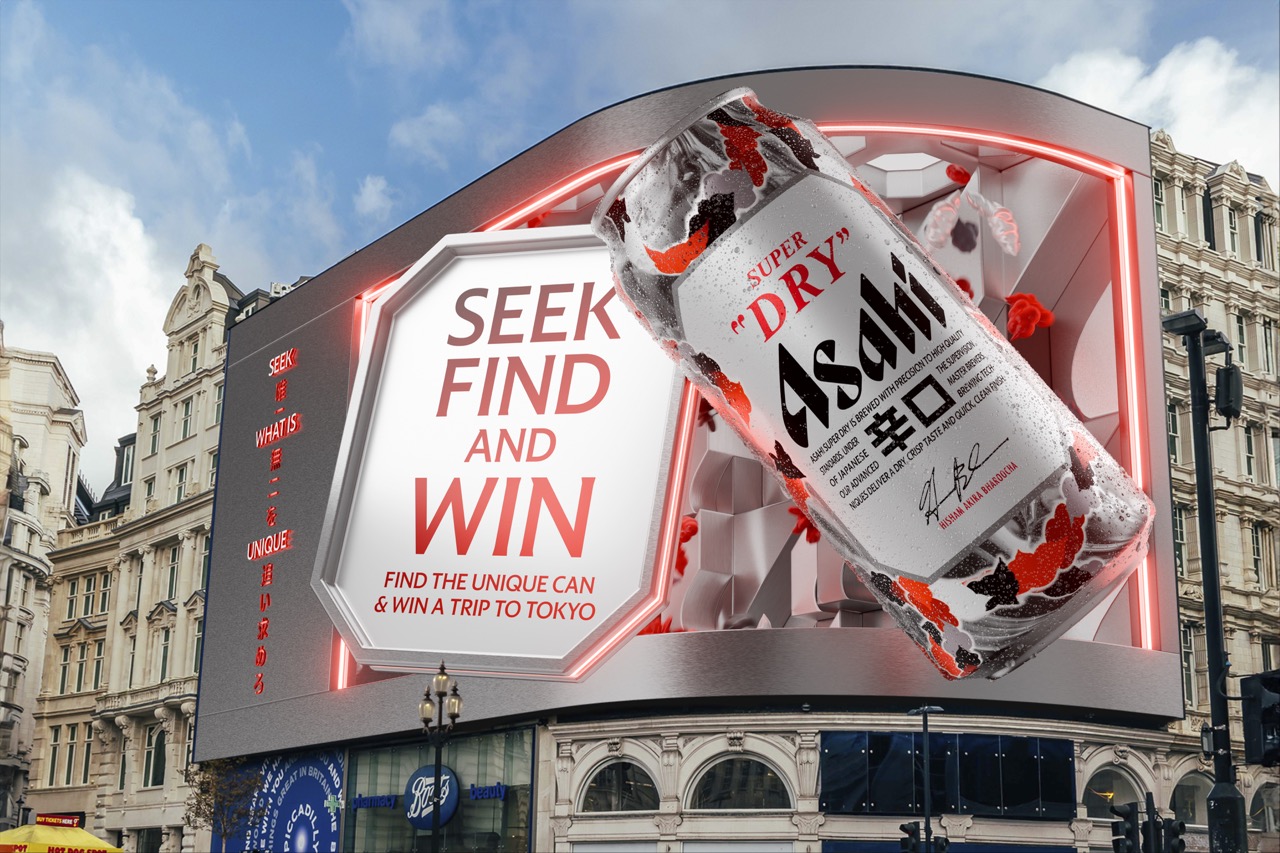
A unique brief calls for a unique solution — and our team delivered. Asahi Super Dry recently unveiled “The Infinite Can”, a first-of-its-kind collaboration with Japanese-born artist Hisham Akira Bharoocha, created with Havas London and POP. The campaign debuted with a week-long takeover of London’s Piccadilly Lights with an evolving, never-the-same-twice billboard. To achieve that, the brief asked for hundreds of unique can and environment variations with a clear artistic signature and the ability to scale that language across motion‑ready assets.
One thing was clear: Off‑the‑shelf generative tools wouldn’t cut it.
To fuse Hisham’s creative logic with Asahi’s brand world at volume, the campaign needed a bespoke AI system built around craft, control, and repeatability. Enter the Asahi Fusion Designer: a custom orchestration tool developed within POP’s Vermeer.ai ecosystem, designed to translate and scale Bharoocha’s artistic language. The process involved deep analysis of his work, with elements such as colours and compositional principles being extracted and codified into a framework. This framework ensured every output feels true to the artist’s intent and the Asahi brand, while allowing for continuous variation: +400 artworks were brought to life, ensuring the experience is never the same twice.
To better understand how it happened, we spoke with Simon Allinson, Head of Creative Innovation and one of POP’s minds behind the process. He talked to us about the extensive research and R&D beforehand, the close connection with the artist throughout the journey, and the pioneering ways Vermeer.ai is helping to translate process, intention, and values into concrete, crafted output.
Scroll to discover not only on the intense technical innovation behind this campaign, but also on the ways human insight and judgement remained at the centre of it all.
What was the original challenge brought to POP, and when did you/the team realise this idea needed a bespoke AI solution?
The brief was to create a series of unique cans for Asahi Super Dry in collaboration with the artist Hisham Akira Bharoocha: a living, expanding family of designs that could scale to a full campaign, including unique designs for the cans, environments, and flexible motion-ready assets.
The moment we knew off-the-shelf tools wouldn’t cut it was when we mapped out what we needed and explored the concept in depth. To produce hundreds of designs, how could we scale Hisham’s artistic style, and fuse it with the Asahi brand world?
AI felt like the answer, but it needed some creative thinking to combine craft, scale and AI in the right way.
What came out was a bespoke pipeline for Asahi, starting with a deep research process, AI R&D, building a series of AI workflows, and designing an AI artistic interpretation engine that would result in truly unique creations.
All of this was orchestrated by a piece of custom software we built for this campaign, the Fusion Designer – which could leverage the Vermeer.ai (POP’s proprietary Gen-AI solution) ecosystem of tools and help us realise this fusion between Asahi and Hisham at scale.
How did the team work with Hisham Akira Bharoocha to translate his artistic language into a creative framework without simply replicating his existing work — and keeping his authenticity?
From early testing we could see the limitations when trying to produce unique work with the small sample of licensed artwork from Hisham. We weren’t merely trying to wrap these cans with artwork — we wanted to create something new. We needed to go beyond the artwork and understand more about process, intention, and artistic values — things that require a conversation with the mind behind the work.
We started with a series of workshops to explore the brand, the concept, and Hisham’s artistic process. We began to extract some of that to create a series of authored parameters — artistic directions like “Morphing Fluidity,” named colour worlds, and more. We discussed how Hisham thought his work could move from flat to 3D to create translation methods describing how 2D artwork becomes 3D surface treatment.
We were also rights-conscious by design. Twenty-four of Hisham’s original works were used with explicit permission, while his inspiration and references were used as generic descriptions. He was involved throughout development, and I hope he enjoyed the process! The result is a system that generates within his creative logic rather than trying to copy his work and does this with licensed inputs and own-able outputs that come from a highly intentioned, human-authored process.
If you could explain the development of the Asahi Fusion Designer in an easy and digestible way, how would you do that?
Imagine a series of dials carefully chosen and neatly arranged, connected to a clever machine that knows how best to take your decisions and turn it into new artwork. A screen shows you designs for approval, re-run, or rejection and on your sign off, the final artwork is created perfectly to spec.
You can experiment with the dials to vary the ingredients of a design: a mood, the level of abstractness, a colour world, a motif, one or more of Hisham’s artworks or shapes. Press generate, and the production line takes over and guides you through the process.
In generative AI, the ‘seed’ is a random number that can help give variety to AI generations by setting a random value to choose the mathematical place to start.
However, nothing about this project was random — it was all intentional. So, how do we avoid a dice roll but retain unique designs? We invented the ‘seed-artwork’, a piece of design that was created at the beginning of the pipeline that would influence the can and environment but was firmly based on all the ingredients that were dialled in.
This meant we could introduce a unique but intentional starting point for the generations for maximum control and variability in one.
All of this is orchestrated by the Fusion Designer and interpreted by the Fusion Intelligence engine — where we set a series of five design personas based on the Asahi brand principals. The personas could add their own flavour to the process and allow more refinement of the design, whilst adding more opportunity to be divergent at scale.
One user can select, generate, review, and export hundreds of complete design families in a session — work that would previously have taken a studio weeks or cost a huge amount to create.
You mentioned that much of the structural thinking, prompts and pipeline logic was done upfront. What did that planning phase involve, and why was it so critical to the project’s success?
The planning phase was about essential research and development on how generative image models actually behave, before committing to an architecture. We ran systematic tests and codified the learnings into rules the whole pipeline is built on.
I can mention a few examples. Structured prompts beat long paragraphs for precision — clear fields give the model clearer constraints. Outpainting beats composition — asking the model to “replace the white background” around a finished can preserves the can’s size and integrity; asking it to “place the can into a scene” does not. Explicit label text makes results worse — counterintuitively, spelling out the copy in a prompt degrades output, since image models often struggle with text at small sizes, so we decided that text and brand artwork should be non-AI processes. Zone mapping — this was a particularly effective way to control the output. Colour-coded maps told the model exactly which regions are protected (the label), and which were the creative canvas (the can body and background).
Because generation at scale is expensive in both credits and time, getting this right upfront was the difference between a system that produces usable work at high approval rates and one that burns budget on retries.
The prompt logic, the stage boundaries, and the queue architecture all flow from those early findings. All of this was technical work that allowed us to define a process that we could then experiment creatively with.
With the structure built, we could then focus on the creative ideas for the work.
In our conversations in the research phase we discussed Hisham’s work and looked through some examples of initial designs to see what landed and what seemed off. We also talked at length about how best to fuse Hisham’s work with the Asahi brand world. It was this deep thinking on top of a robust structure that allowed us to craft at scale powered by AI.
The campaign uses an “atomic content” approach, where individual elements can be reused and recombined. What advantages did that give the team from both a creative and production perspective?
Every parameter — a colour world, a motif, a translation method — is an independent element, so a successful ingredient can be recombined endlessly into new families.
However, we were careful from the beginning to think about how we might need to adapt the work in the end. The hero asset was a can and environment in a landscape image. However, because we thought atomically, we built a process that gave us individual layers: the can, can with condensation, the environment, the composite, and the final asset with artwork applied. We could then re-frame the environment to provide the correct viewing angle for the hero display at Piccadilly Lights to make sure the designs would work for standard OOH and for the forced perspective of the takeover.
Atomic by design is a great approach and gives us so many opportunities to be creative with our deliverables and make sure we get the most out of everything we create for a campaign.
What were the biggest challenges the team encountered during the process, and how were they solved?
Text fidelity. Generative models cannot accurately reproduce small typography — and we tested this thoroughly, including newer models that didn’t help. Our solution: combine the best of AI process with traditional processes. AI does what it’s good at (surfaces, light, scenes); deterministic image processing does what it’s good at (pixel-perfect type).
Size and scale drift. Early scene generations would resize or “monumentalise” the can. Switching from composition prompts to outpainting — treating the can as fixed and generating the world around it — solved it.
Consistency at scale. Fifty families running concurrently through six stages needs orchestration. We built a unified dispatch queue with stage-based priority ordering, per-stage approval tracking, and real-time credit monitoring, so the pipeline stays observable and controllable rather than a black box.
Quality trade-offs. Even resolution turned out to be a creative decision — 2K gave better text accuracy while 4K gave better overall quality — the kind of finding you only get from disciplined testing.
What would you say was the key element to delivering this work combining scale with craft, consistency, and quality?
Separation of concerns: humans make choices, machines run the process, and every output passes through a human judgment gate.
All 149 parameter options were individually written by us from our R&D process and testing. The pipeline guarantees consistency through structured prompts, zone maps, and locked constraints, so scale doesn’t dilute the craft. And nothing ships on generation alone: every family passes through a review workflow with approval ratings before export. The system tracks approval ratios and attempts-per-approval per stage, so quality is measured and we can fix issues in flight.
Human craft is front-loaded into the framework; the scale is automated; but judgement and taste remain human choices.
Looking back on the project, what does the Infinite Can reveal about the future relationship between human creativity and AI-enabled content production?
The Infinite Can suggests the artist’s role is elevated, not replaced. Hisham couldn’t possibly have created thousands of cans, and his work defined a creative universe with enough intentionality that every point within it carries his authorship. The AI is the means of exploring that universe; the boundaries, the taste and the rules remain entirely human.
It also shows that the future of AI production is systems and creative thinking, not writing prompts. The value wasn’t in any single generation, it was in the upfront structural thinking: the framework, the tested prompt logic, the pipeline, the review discipline. That’s creative direction evolving into something closer to designing the conditions for creativity at scale.
And finally, it demonstrates that scale and integrity aren’t opposites. With rights-conscious foundations, encoded artistic principles and human approval gates, you can produce at a volume no studio could match while every output still feels considered.
Infinite might be AI enabled, but the craft is still very much human driven.
Want more POP in your feed? Make sure to follow us on Instagram and LinkedIn to never miss a thing!
Comments are closed.