
Inside the Jury Room: Lez Rudge on the D&AD Awards Experience
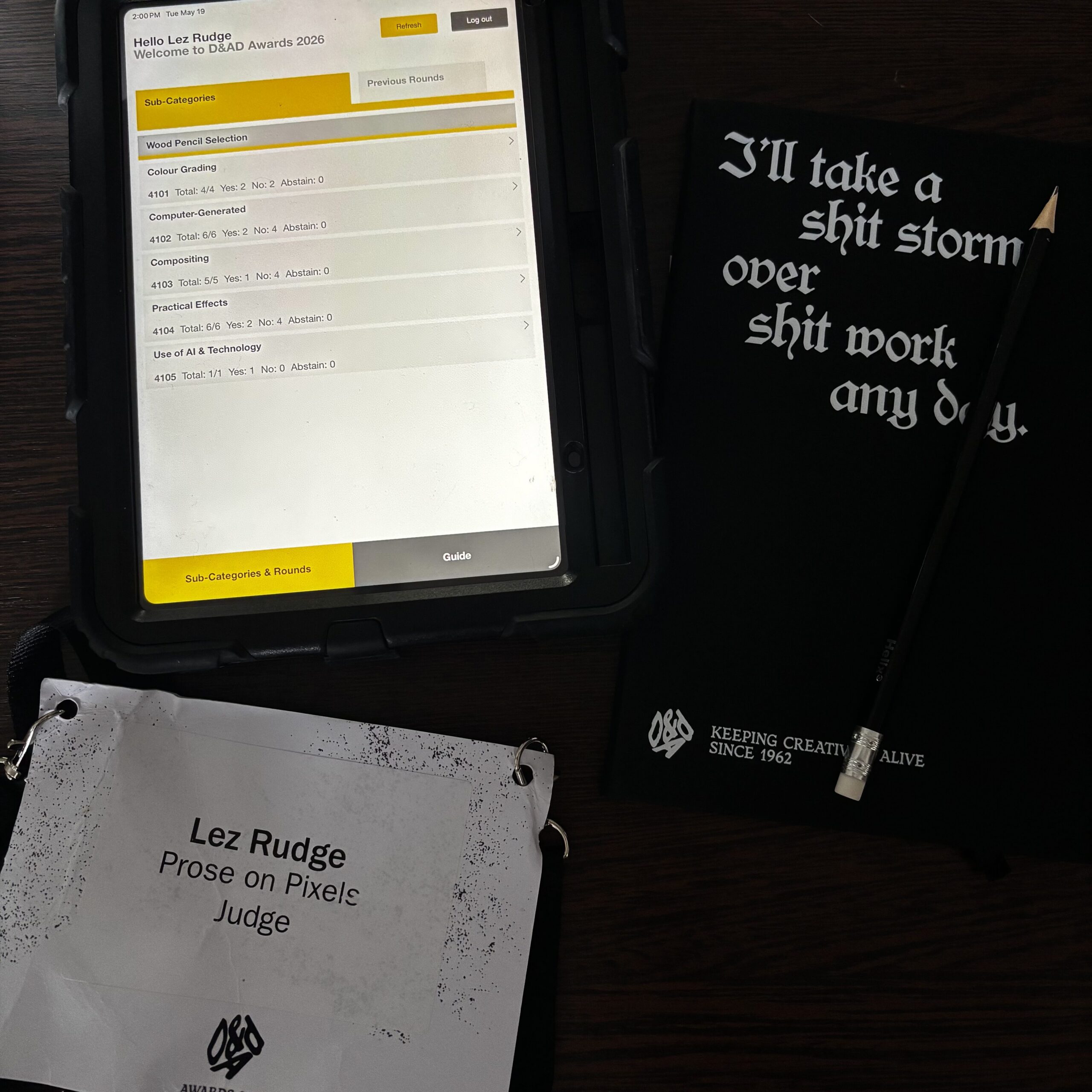
This year, Lez Rudge, our Head of Color, US, was part of the selected group of jurors of the iconic D&AD Awards – a squad that took the challenging and exciting mission of selecting some of the best work in the industry. While bringing his decades of craft, mentorship, and storytelling background to the Visual Effects category, Lez also experienced the behind-the-scenes of the awards first hand – wrapping the week ready to share all the details from inside the room.
A globally seasoned colorist and creative director, Lez always offers a precise, narrative‑first lens, honed across award‑winning work and prior jury experience with AICP, The Gail Awards, and the Webby Awards.
In this conversation, he reflects on the collective energy of the D&AD room and unpacks a rigorous, multi‑stage process — from early online voting to in‑person deliberations awarding Wood, Graphite, and Yellow Pencils.
Keep reading to hear from Lez himself!
How was the experience in general?
The experience was incredibly stimulating, both intellectually and creatively. But what stood out most for me was the collective energy in the room. There was a palpable sense of excitement and enthusiasm that really elevated the entire process. Being surrounded by such engaged and passionate peers created an atmosphere that felt both inspiring and energising, almost electrifying at times.
How did you evaluate colour, visual craft and innovation in the category?
The evaluation process began about a month prior with an online voting phase, where an initial pool of entries was reviewed and narrowed down. From there, we were presented with a curated shortlist during the in-person judging sessions.
The judging itself unfolded across several rounds, progressively refining the selection to determine which pieces would receive Wood, Graphite, and ultimately Yellow Pencil awards. Each stage required careful consideration of craft, excellence and innovation, not just as standalone elements but in how effectively they came together to enhance the overall work.
What made the process particularly enriching were the discussions. They were thoughtful, dynamic, and often challenged our individual perspectives. On several occasions, the group – myself included – found our views shifting as a result of hearing others’ interpretations and insights. This openness to debate and reevaluation ensured that the final decisions felt considered and collectively robust.
Which insights and learnings stood out for you?
One strong reaffirmation was just how subjective art truly is. Different styles, perspectives, and cultural references resonate in unique ways with each individual, and that diversity of interpretation is what makes the process so rich. There isn’t a single “right” or “wrong”. It’s about the strength of the idea and how it connects. Interestingly, despite this subjectivity, there was one notable moment of alignment: we were all unanimously in agreement on the Yellow Pencil winner in the Visual Effects category. That level of consensus was both surprising and insightful – it highlighted that truly exceptional work has a way of cutting through personal bias and speaking to everyone on a fundamental level.
Want more from POP? Don’t forget to follow us on Instagram and LinkedIn to get all the news on AI, innovation, creativity, and craft!
Comments are closed.