
Inside Adobe Summit 2026: How AI Is Transforming Content Creation and Workflows
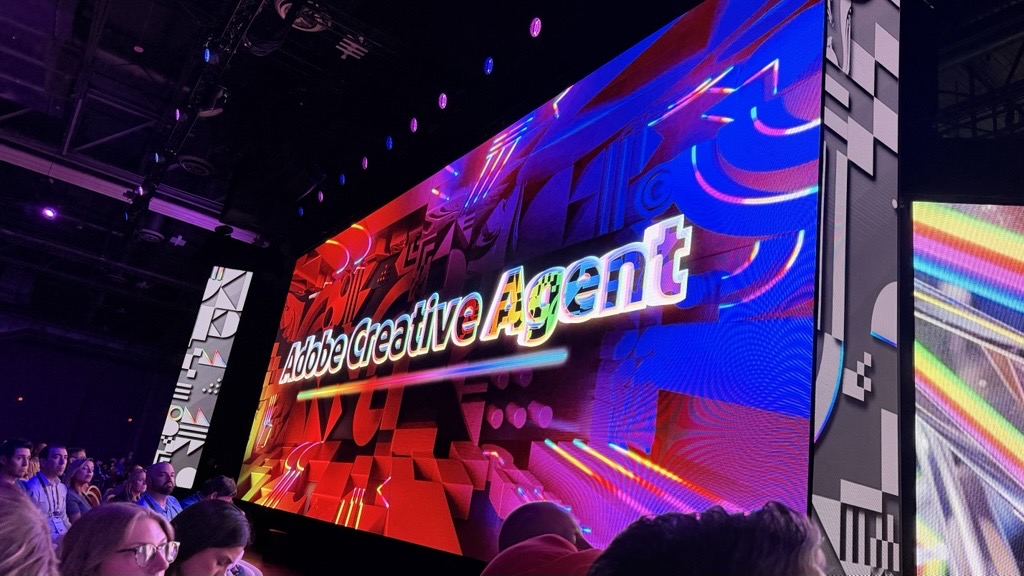
POP was on the ground at Adobe Summit 2026 in Las Vegas — as Adobe partners, we had a front seat at the event for the latest releases and conversations. When important industry discussions about innovation are taking place, POP is in the room – this time, with Stefane Rosa, CEO US; Gregory Roekens, Global CTO; Paul Ward, CEO UK & Global President.
Across keynotes, sessions, and conversations, themes like agentic AI, content supply chain transformations and scalability stood out. The conclusions about this 2026 edition are clear: the Summit marked an inflection point for the industry — not because it introduced a distant vision of the future, but because it confirmed that much of that future is already here. As Paul summed it up, “Adobe made a bunch of announcements that blew my mind.”
AI was, of course, at the centre of it all. However you look at it, it is no longer emerging at the edges of creative and marketing workflows, but embedded directly within them, shaping how content is created from end to end. At POP, we’ve been seeing the impact of this transformation on the work we deliver to clients – continuously enhanced by the updates and insights we take from events like this.
The future is already here
At this year’s Adobe Summit, the future that AI promised has officially materialized. Its integration into everyday work is no longer a far-off dream — it’s our reality. “A lot of the conversations happening at Adobe Summit were the same ones we’ve been having day to day at POP,” said Stefane. “It felt less like a glimpse into the future and more like confirmation that the direction we’re headed in is the right one.”
Those conversations center on some of the most pressing and persistent challenges facing modern marketing teams – the bread-and-butter of what we support clients with every day:
- How to scale content without diluting quality
- How to maintain creative consistency across an ever-expanding number of channels
- How to meaningfully connect creative output with data and performance.
The rise of agentic AI
One of the most defining themes from the Summit was the emergence of agentic AI — not just as a concept, but as something actively being built into workflows. Adobe’s vision centers on intelligent agents operating across the content supply chain, supporting all aspects of production.
“Every keynote we saw talked about how a new workflow or tech offering will be supported by agents to cover compliance, quality control, brand guardianship, process enhancement, and more”, said Paul. “As Gregory Roekens kept telling me, our workforce is multiplying at a pace we’ve never experienced. Only this time it’s not with a higher headcount in London, New York or Chennai — rather, it’s cloud-based agents working alongside other agents, and in some cases being marshalled by more agents again.”
“Agentic systems massively expand production capacity,” Gregory added, “which is brilliant news for anyone who can do more ambitious work with the same team.”
This fundamentally changes how teams think about production and capacity. Mundane, monotonous tasks can now be distributed across agents, freeing up human teams to focus on higher-value work. AI is reshaping workflows entirely. The challenge now is learning how to direct, structure, and collaborate with this growing network of agents.
Capitalizing on bot-to-bot communication
The rise of agentic AI and the integration of bots into every aspect of the marketing funnel presents a unique opportunity, if agencies and brands can seize it. “If agents are increasingly becoming the audience, then every machine-readable surface — product data, support docs, legal copy, structured metadata — becomes brand,” said Gregory. By considering agentic AI as an audience for aspects of branding that would not concern the average human audience, brands can take advantage of new space.
This new audience is yet another moment brands and agencies can use to break down silos and collaborate. “That’s a remit no single function owns, and it’s exactly the kind of cross-disciplinary brief that creative, technology, content and data partners are built to lead together,” he continued. “It’s a growth opportunity dressed as a complexity problem.”
Connecting the content supply chain
There’s a growing emphasis on unifying the entire content lifecycle — from ideation to production, distribution, and measurement. “The buzz around AI also felt different,” said Stefane. “Less noise, less experimentation for the sake of it, and more integration into actual workflows. It’s not sitting on top of the process anymore — now, it’s becoming part of how the work gets done, from start to finish.”
Adobe’s vision of a connected ecosystem is certainly being realized. But it’s how you use it that really matters. “Adobe Brand Intelligence is genuinely impressive — a system that learns your brand from feedback loops over time,” Gregory mentioned. “But every Adobe customer will have one. The brands, agencies and studios that will win in 2027 will be the ones treating brand intelligence as IP — something they shape, own and refine — rather than as a vendor feature they switch on.”
From content to systems
One of the clearest shifts is moving from using AI purely for content creation to building scalable content systems. “The central idea is that you don’t just make something once, but you build something that can evolve, adapt, and scale consistently across channels,” said Stefane. This distinction reframes content not as a series of standalone outputs, but as part of a connected infrastructure designed for continuous use and reuse.
In practice, this means brands are starting to think less about campaigns as isolated bursts of activity and more about building modular systems — where core ideas, assets, and templates can be dynamically adapted across formats, platforms, and audiences. Instead of recreating work from scratch every time, teams are investing in foundations that can flex and extend.
Scaling output with good ideas
With scale comes an increasing dependence on the initial idea. “Without something strong at the core, scaling just multiplies mediocrity,” Rosa added. “So, in a way, all this technology is putting even more pressure on getting the idea right from the beginning.”
This shifts how value is created. Efficiency, automation, and distribution matter, but they are ultimately multipliers — they amplify whatever sits at the core, so a strong idea can become exponentially more powerful.
As Roekens put it, in the age of near-infinite scalability, “what becomes scarcer, and therefore more valuable, is taste — knowing what’s worth making, what’s worth saying, what to cut. The studios and creative teams who lean into that editorial role, with agents as collaborators rather than competitors, are going to do the most interesting work of their careers.”
The pressure is no longer just on execution or output, but on clarity and originality at the point of conception. Getting the idea right early is foundational to everything that follows. In a world where scaling in content systems is the norm, the competitive advantage comes from ensuring that the fundamental idea is worth scaling in the first place.
Looking towards what’s next
The future the industry has been anticipating has arrived — and it’s already embedded in the way work is being done. What once felt speculative is now operational, as AI transitions from being an experimental capability to a connective thread running through the entire content ecosystem.
The AI landscape of today is characterized by rapid shifts and constant innovation. “There have been more changes — and there will no doubt continue to be more to come — in recent times than I’ve experienced in my entire career”, said Paul. “The number of new platforms, processes, inventions, and indeed fully funded start-ups which seem to be dropping on a weekly basis make it difficult to keep up. Thankfully, as I heard many times over at Adobe Summit, I’ll be able to get an agent or two to help me make sense of it all.”
Gregory reflected about the edition. “Summit 2026 sold the destination beautifully. The route map — turning the vision into governed, on-brand, measurable work at scale — is where the most interesting collaborations of the next two years will happen.”
For POP, that road map is full of innovation and opportunity. And we are on the right road — many of the conversations heard on stage are the same ones already happening with clients and partners like Adobe every day. That makes the AI reality we live in less of a revelation and more of a validation of the direction we’re already going. As Paul Ward says, “We’re in good hands — even if a number of them are synthetic.”
Want more POP in your life? Keep up with us on LinkedIn and Instagram to never miss a thing.
Comments are closed.